The Connection Between ADHD and Executive Dysfunction
Have you ever felt like the list of things to do keeps adding up in your head and your ability to handle them lessens? If…
In crisis? Call or text 988.
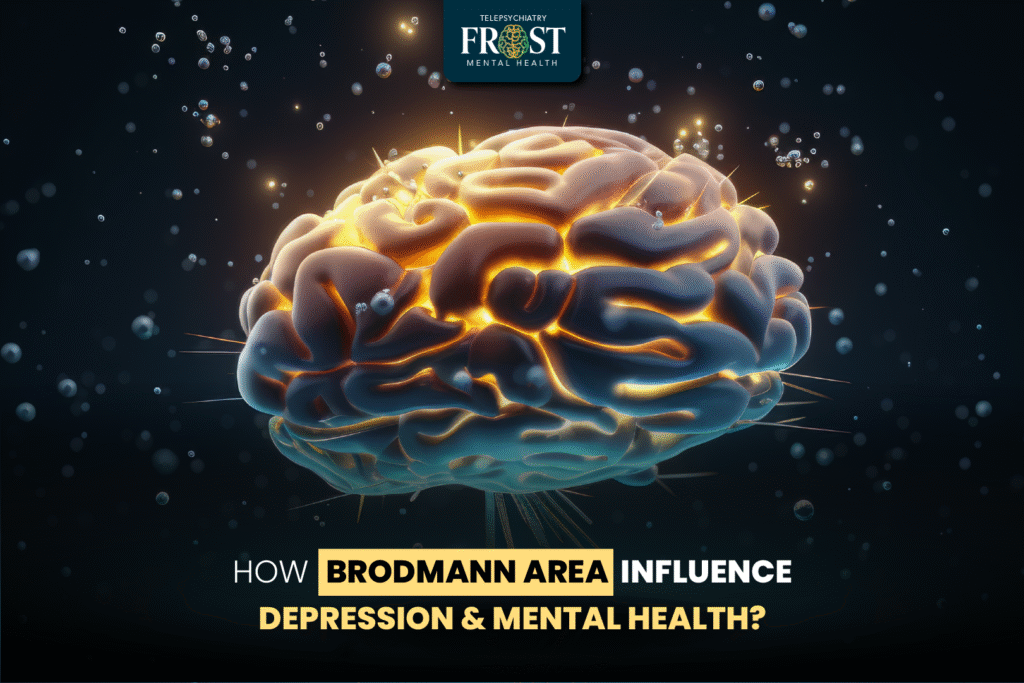
Depression and other mental health disorders are complex and involve multiple brain areas.
Scientists have identified Brodmann areas. These areas are key for thinking, feelings, and how we act.
Knowing these brain association areas helps us understand depression and mental health.
Below, we’re diving into Brodmann’s areas. We’ll see what they do and how they impact mental health, paying special attention to depression.
At Frost Mental Health, we offer guidance and support for mental health challenges. Our services provide information on psychiatric medications, including their effects and risks.
We also conduct tests analyzing genes to help in diagnosis and treatment. For more details, please contact us.
In 1909, Korbinian Brodmann, a German brain doctor, labeled 52 parts of the brain’s outer layer.
These particular parts are now called Brodmann areas, named for the unique cell makeup in each area.
Different areas have certain jobs, like understanding our senses or navigating tough feelings.
Today, Brodmann’s areas list is fundamental in understanding mood disorders like depression.
To give an example, Brodmann area 10, it’s super important for making choices and remembering things. Then there’s Brodmann area 46, which helps us move and think with purpose.
Some areas handle simple tasks, yet some are key to our mental wellness.
Scientists are particularly interested in Brodmann area 25, as it seems to play a role in having low moods and managing feelings.
The frontal lobe’s deep part has a small but powerful area called Brodmann area 25 or the subgenual cingulate cortex. This identity is connected to how we feel and process emotions.
Area 25 helps control our feelings. It acts like a junction box, linking parts of our brain that deal with mood, stress, and emotional reactions.
It’s like the command center for how we respond to things that stir up our feelings. So, it’s super important in conditions that affect our mental health, such as depression.
Brodmann area 25 is in the subgenual cingulate cortex. It’s small but vital for mood and depression. When it gets overworked, we experience stuff like sad feelings, worry, and lack of the urge to do anything.
Now, let’s imagine a person with a stubborn kind of depression, brain area 25 is going into overdrive. Parts of our mind, such as the amygdala and prefrontal cortex, become tangled when dealing with our feelings.
Researchers use a technique called Deep Brain Stimulation to address this, primarily focusing on area 25.
DBS acts like a reset button for this overworked part of the brain. That’s how it helps people who can’t find help with regular medicine or talk with a therapist.
The part of the brain’s subgenual cingulate cortex is important to help manage how we feel and how we deal with negative stuff. Too much action in the area 25 part of the brain can cause long term sadness and worry.
Sometimes people with extreme mood problems have lots going on in this area even when nothing bad is happening. Area 25 also links to other brain sections that handle body stuff.
They deal with sleep, hunger, and energy. That might be why people who feel low a lot also feel tired, don’t eat right, or have trouble sleeping.
Area 25 is key to understanding depression, but other Brodmann areas also matter.
Located in the prefrontal cortex, area 10 Brodmann is responsible for decision making and planning. Dysfunction here is linked to symptoms like indecisiveness and lack of motivation in depression.
Also in the prefrontal cortex, it aids working memory and complex tasks. Depression often brings focus and memory issues, linked to problems in this area.
Area 22, located in the temporal lobe, is vital for language and understanding. Its link to depression is unclear. Yet, severe depression hampers communication and thought, hinting at a possible connection.
Consider the brain’s emotion centers, like Brodmann area 25. When they’re overactive, they disrupt thoughts and feelings. This often happens in major depression or bipolar disorder.
Other areas, such as the medial superior temporal area, manage vision and movement. These can be affected too, but it’s rare.
It’s like a domino effect in the brain, one issue triggers another. For instance, Brodmann area 10 and area 25 are linked. Problems in either can throw off mood balance.
Brodmann areas do more than regulate emotions. They also handle sensory processing and motor functions.
For example, the primary visual cortex contains a map of visual space. This helps us see and understand our surroundings.
Sensory processing issues can worsen anxiety or stress, linking them to mental health.
Two point discrimination helps us feel two distinct points on our skin. It’s especially acute in our hands. This ability relates to somesthetic sensation. It is managed by the Brodmann area in the cortex 3. While not directly tied to depression, sensory perception issues can worsen emotional problems.
Area 25 affects mood and emotional control. It’s located in the brain’s front part and is linked to depression and mood disorders.
Stimulating this area, whether electrically or by other means, can reduce depression and improve mood. This happens because area 25 helps manage emotions and connects with other mood regulating brain areas.
Researchers and doctors aim to treat severe depression and similar conditions by adjusting area 25’s activity.
Researchers are focusing on Brodmann area 25 to fight depression.
As mentioned earlier, they use Deep Brain Stimulation for severe cases unresponsive to other treatments. Electrodes are placed in area 25 to adjust their function.
Another method, Transcranial Magnetic Stimulation (TMS), is gentler. It applies magnetic energy to area 25. TMS has reduced depression signs in some people. It helps manage emotions.
Cognitive behavioral therapy (CBT) also works by altering brain function. It targets the emotion regulating part and the prefrontal cortex.
CBT turns negative thoughts into positive ones. This reduces activity in Brodmann area 25, leading to improved well being.
Brodmann areas and depression reveal key insights into mental health biology. Areas 10, 22, 25, and 46 are crucial for mood, emotion, and thought control.
Understanding these areas has paved the way for treatments like DBS and TMS, offering new hope for those with depression.
We still need to understand how each Brodmann Area affects mood and behavior. Yet, research is making progress in treating depression.
Targeting specific brain areas can help us create better mental health treatments. They would be more personalized and effective.
Damage to Brodmann area 46 can hurt cognitive control and working memory. This, in turn, makes problem solving and strategic thinking harder.
Not all Brodmann areas are linked to mental health. However, many are vital for cognitive function, emotional control, and sensory processing. These factors influence mental well being.
Virtual appointments for adults in California & Florida. We reply within one business day.
Have you ever felt like the list of things to do keeps adding up in your head and your ability to handle them lessens? If…
Managing one mental health condition is hard enough for anyone. But what if instead of one disorder, your brain deals with two conditions at the…
While a lot of people know dopamine as the 'feel good' chemical, more people are not aware of its role in mental health.Precisely, there…